
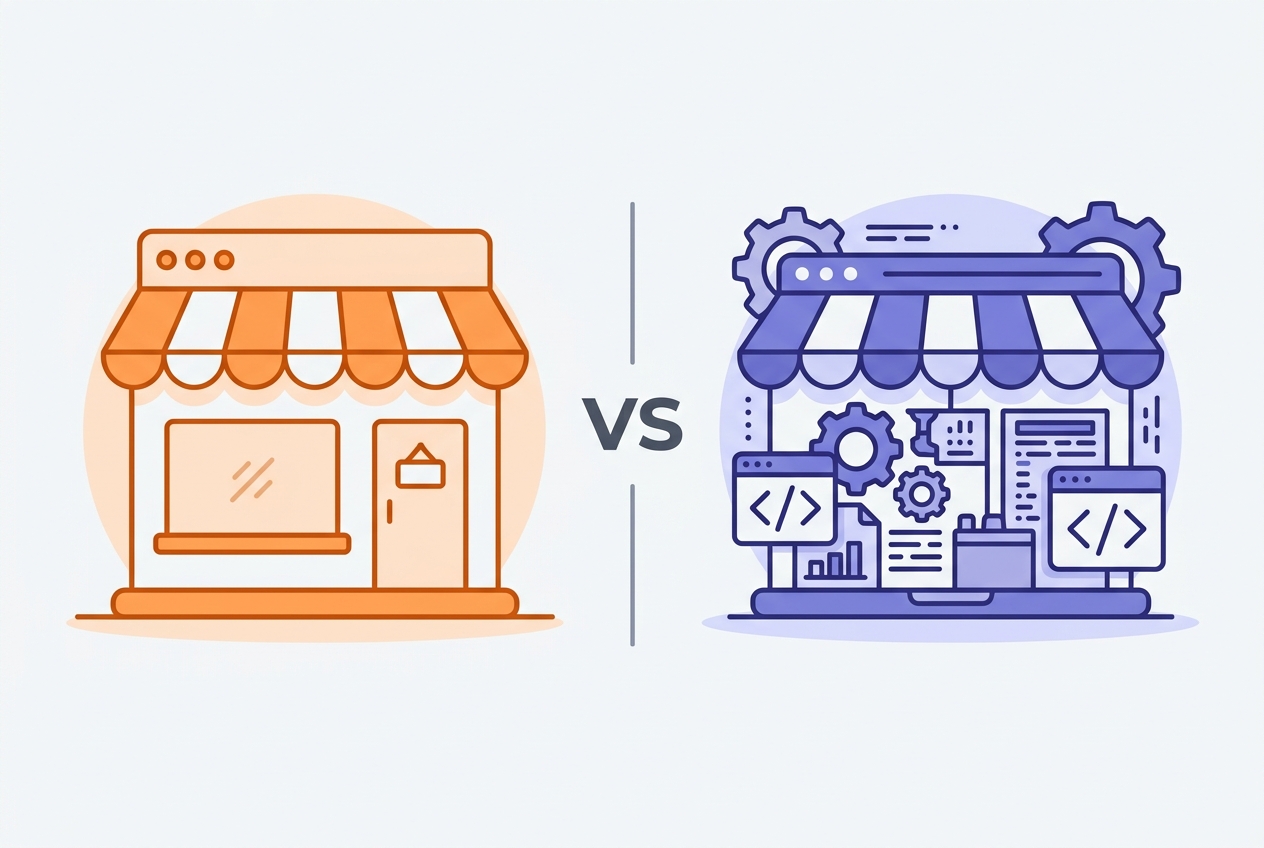
Shopify and Magento (now Adobe Commerce) are two of the most established e-commerce platforms, but they serve very different types of businesses. Shopify is a hosted SaaS platform that prioritizes ease of use and speed to market. Magento is an open-source platform that offers maximum customization but requires significant technical resources. This comparison helps you decide which platform is right for your business in 2026.
Platform Overview
Shopify
Shopify is a fully hosted e-commerce platform used by over 4 million stores worldwide. You pay a monthly subscription and Shopify handles hosting, security, updates, and PCI compliance. Shopify offers plans from $39/month (Basic) to $2,000+/month (Plus) for enterprise needs.
Magento / Adobe Commerce
Magento comes in two versions: Magento Open Source (free, self-hosted) and Adobe Commerce (paid, cloud-hosted). Magento Open Source requires you to handle hosting, security, updates, and PCI compliance yourself. Adobe Commerce includes cloud hosting and premium features but starts at approximately $22,000/year for small businesses and can exceed $100,000/year for enterprise.
Cost Comparison
Shopify Costs
- Basic: $39/month (2.9% + $0.30 per transaction with Shopify Payments)
- Shopify: $105/month (2.6% + $0.30 per transaction)
- Advanced: $399/month (2.4% + $0.30 per transaction)
- Plus: From $2,000/month (custom transaction rates)
- Apps: Most stores spend $50-$300/month on apps
- Theme: Free themes available; premium themes $180-$350 one-time
Total first-year cost for a typical Shopify store: $2,000-$8,000 (excluding custom development).
Magento Costs
- Open Source license: Free
- Hosting: $200-$2,000+/month for production-grade hosting
- Development: $20,000-$100,000+ for initial build (Magento requires developers)
- Maintenance: $500-$5,000/month for ongoing development, security patches, and updates
- Adobe Commerce: $22,000-$125,000+/year for the license alone
- Extensions: Premium extensions range from $100-$1,000+ each
Total first-year cost for a typical Magento store: $40,000-$150,000+ (Open Source with custom development).
Ease of Use
Shopify wins decisively. A non-technical person can launch a Shopify store in a day. The admin interface is intuitive, the theme editor is visual, and thousands of apps extend functionality without code. Magento requires developer involvement for almost everything beyond basic product management.
Magento admin interface is functional but complex. Tasks that take minutes in Shopify (adding a product, changing a price, updating a page) can take longer in Magento due to the more complex admin structure, caching systems, and indexing requirements.
Customization and Flexibility
Magento wins here. Magento is open source, meaning you can modify literally anything: the checkout flow, the database schema, the admin interface, the API layer, everything. Shopify is a closed platform; you customize within the boundaries Shopify provides (themes, apps, checkout extensions, Shopify Functions).
However, Shopify checkout extensibility and Shopify Functions have narrowed this gap significantly. Most customizations that previously required Magento-level flexibility can now be achieved on Shopify through its extensibility framework. The remaining gap matters mainly for highly specialized B2B workflows, complex multi-store setups with shared inventory, or businesses with regulatory requirements that demand on-premise hosting.
Performance and Scalability
Shopify wins for most businesses. Shopify hosting is managed by Shopify across a global CDN. Page load times are consistently fast, and the platform has handled massive flash sales (Kylie Cosmetics, Gymshark) without issues. You never need to think about server configuration, caching, or scaling.
Magento performance depends entirely on your hosting and optimization. A well-optimized Magento store on premium hosting can perform excellently, but achieving that performance requires expertise in server configuration (Varnish, Redis, Elasticsearch), code optimization, database tuning, and CDN configuration. A poorly optimized Magento store can be painfully slow.
B2B and Multi-Store
Magento has an edge for complex B2B. Magento natively supports multiple stores from a single installation with shared or separate product catalogs, customer databases, and admin panels. The B2B module (Adobe Commerce) provides advanced features like requisition lists, company accounts with hierarchical user roles, shared catalogs with complex pricing matrices, negotiated quotes, and purchase order workflows.
Shopify Plus B2B features have improved significantly but are still less mature than Magento for complex wholesale operations. For straightforward B2B (customer-specific pricing, registration/approval, volume discounts), Shopify Plus or Shopify apps like DX Wholesale B2B Kit handle it well. For enterprise B2B with complex organizational hierarchies and procurement workflows, Magento still has an advantage.
SEO
Both platforms support strong SEO. Shopify handles technical SEO well out of the box: clean URLs, automatic sitemaps, SSL, fast page loads, and mobile-optimized themes. Magento offers more granular SEO control (custom URL structures, advanced canonical tag management, layered navigation SEO) but requires developer involvement to configure properly.
For most businesses, Shopify SEO capabilities are more than sufficient. The ease of publishing content and making changes quickly on Shopify often results in better SEO outcomes than Magento, simply because teams can execute faster.
Security
Shopify wins. Shopify handles all security: PCI DSS Level 1 compliance, SSL certificates, security patches, and DDoS protection. You never need to worry about a security vulnerability in your e-commerce platform.
Magento Open Source security is your responsibility. You must apply security patches promptly (Magento releases them regularly), maintain PCI compliance for your hosting environment, monitor for vulnerabilities in third-party extensions, and handle SSL, firewall, and intrusion detection. Magento stores that fall behind on security patches are frequent targets for credit card skimming attacks.
When to Choose Shopify
- You want to launch quickly without heavy upfront development costs
- Your team is not highly technical and needs an intuitive admin
- You sell DTC (direct to consumer) or have straightforward B2B needs
- You want predictable monthly costs without server management
- Speed, security, and reliability are priorities over maximum customization
- Your annual revenue is under $50M (Shopify Plus handles well above this, but the sweet spot is clear)
When to Choose Magento
- You have complex B2B requirements with organizational hierarchies and procurement workflows
- You need multiple stores with deeply shared backend systems
- Regulatory requirements mandate on-premise or specific geographic hosting
- You have an in-house development team capable of maintaining Magento
- You need customization depth that goes beyond what Shopify extensibility offers
- Budget is not a primary constraint and you can invest $50,000+ in initial development
Migration Considerations
If you are currently on Magento and considering Shopify, migration is very achievable. We have guided many merchants through Magento to Shopify migration including product data, customer data, order history, SEO URLs, and 301 redirects. The most common reason for migration is reducing total cost of ownership and eliminating the need for dedicated Magento developers.
If you are on Shopify considering Magento, carefully evaluate whether the additional customization Magento offers justifies the significantly higher cost and complexity. In most cases, Shopify Plus with the right apps and custom development covers the requirements.
Need help deciding between Shopify and Magento, or ready to migrate? DigiXoft provides Shopify development services and Magento to Shopify migration. Contact us for a free consultation.
Frequently Asked Questions
Is Shopify better than Magento?
For most e-commerce businesses, yes. Shopify offers lower total cost of ownership, faster time to market, better security, and easier management. Magento is better only for businesses with very complex B2B requirements, multi-store needs, or specific hosting mandates that Shopify cannot accommodate.
How much does it cost to migrate from Magento to Shopify?
Migration costs typically range from $5,000 to $30,000 depending on the complexity of your store, number of products, custom functionality that needs to be recreated, and SEO redirect requirements. The investment usually pays for itself within 6-12 months through reduced hosting and development costs.
Can Shopify handle enterprise e-commerce?
Yes. Shopify Plus powers enterprise brands generating hundreds of millions in annual revenue. Features like Shopify Flow for automation, checkout extensibility, B2B catalogs, multi-currency with Shopify Markets, and the Shopify API provide enterprise-grade capabilities with significantly less complexity than Magento.