
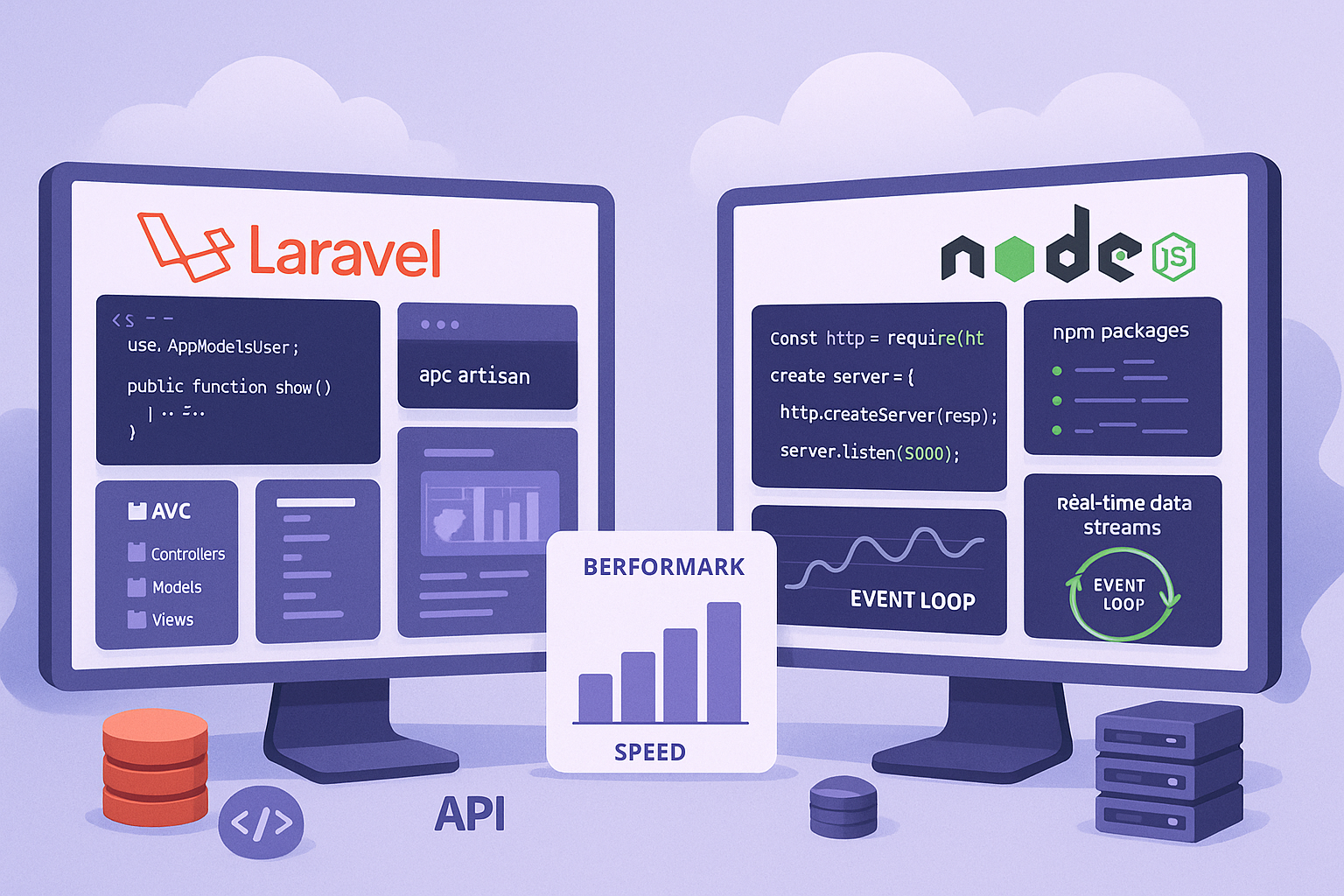
Laravel and Node.js are two of the most popular choices for building web applications, but they take fundamentally different approaches. Laravel is a full-featured PHP framework with built-in tools for routing, authentication, database management, and more. Node.js is a JavaScript runtime that enables server-side JavaScript, typically paired with frameworks like Express.js, NestJS, or Fastify. This comparison covers performance, ecosystem, developer experience, scalability, and use cases to help you choose the right technology for your project.
Overview
Laravel is an opinionated PHP framework that follows the MVC (Model-View-Controller) pattern. It includes Eloquent ORM for database interactions, Blade templating, built-in authentication scaffolding, queue management, and a rich ecosystem of packages. Laravel prioritises developer productivity and code elegance.
Node.js is a JavaScript runtime built on Chrome's V8 engine. It uses an event-driven, non-blocking I/O model that excels at handling concurrent connections. Node.js is unopinionated - developers choose their own framework, ORM, and architecture patterns.
Performance
Node.js generally outperforms Laravel in raw throughput, especially for I/O-intensive applications (API servers, real-time applications, microservices). Its non-blocking event loop handles thousands of concurrent connections efficiently. Laravel, being PHP-based, follows a traditional request-response cycle. While PHP 8.x brought significant performance improvements, Laravel's approach is better suited for CPU-bound tasks and traditional web applications rather than high-concurrency real-time systems.
Developer Experience
Laravel provides a "batteries included" experience. Authentication, database migrations, testing, queues, caching, and scheduling are all built in. This means less decision fatigue and faster project bootstrap. The documentation is excellent and the community is welcoming to newcomers.
Node.js offers more freedom but requires more decisions. You choose your framework, ORM, authentication library, and other components. This flexibility is powerful for experienced teams but can slow down new projects as the team evaluates and integrates different packages.
Ecosystem
Both have massive ecosystems. Node.js has npm with over 2 million packages - the largest package registry in existence. Laravel has Composer packages plus its own ecosystem including Forge (server management), Vapor (serverless deployment), Nova (admin panels), and Livewire (reactive UI). Laravel's ecosystem is more curated; Node.js's is more vast but requires more evaluation.
When to Choose Laravel
Choose Laravel when you are building a traditional web application with server-rendered pages, you need rapid prototyping with built-in tools, your team has PHP expertise, you need a robust admin panel (Laravel Nova or Filament), or you are building a CMS, ecommerce backend, or content-heavy application.
When to Choose Node.js
Choose Node.js when you are building real-time applications (chat, live dashboards, collaboration tools), you need high-concurrency API servers, your team wants full-stack JavaScript (frontend and backend), you are building microservices, or you need streaming or event-driven architectures.
Can You Use Both?
Yes. Many architectures use Laravel for the main application (admin, CMS, API) and Node.js for real-time features (WebSocket server, notification service, data processing). Choose the right tool for each component rather than forcing one technology to handle everything.
Need Help Choosing?
DigiXoft builds web applications with both Laravel and Node.js. Our custom web app development services help you choose and implement the right technology stack for your project. Contact us to discuss your requirements.
Frequently Asked Questions
Is Laravel better than Node.js?
Neither is universally better. Laravel excels at traditional web applications, admin panels, and rapid development with its built-in tooling. Node.js excels at high-concurrency applications, real-time systems, and when full-stack JavaScript is desired. The right choice depends on your project requirements, team expertise, and performance needs.
Is Laravel still relevant in 2026?
Yes. Laravel remains one of the most popular web frameworks globally, with an active community, regular major releases, and a growing ecosystem (Livewire, Filament, Inertia.js). PHP itself has seen major performance improvements in recent versions. Laravel is actively maintained and widely used for new projects.