
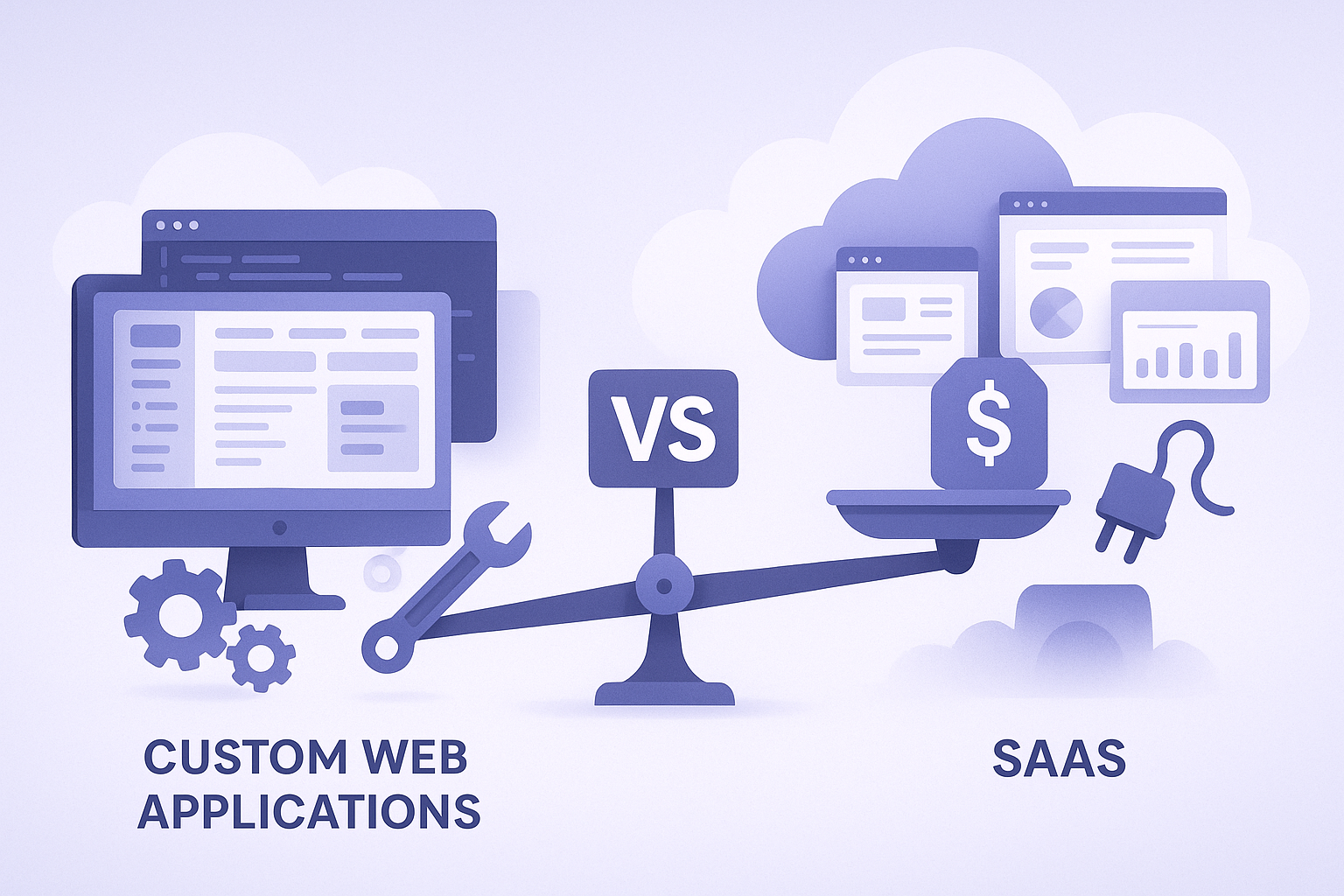
Choosing between a custom web application and a SaaS solution is a fundamental business decision that affects your operations, budget, scalability, and competitive positioning. Both approaches have clear strengths - SaaS offers speed and simplicity, while custom development delivers precise fit and full control. This guide compares both options across every factor that matters to help you make the right choice for your business.
SaaS (Software as a Service)
SaaS products are pre-built software platforms accessed through a web browser and paid for via subscription. Examples include Shopify (ecommerce), Salesforce (CRM), Slack (communication), HubSpot (marketing), and QuickBooks (accounting). SaaS platforms serve thousands of businesses with the same core product, using configuration and integrations to accommodate different workflows.
Custom Web Applications
Custom applications are built from scratch (or on a framework) specifically for your business. Every feature, workflow, and interface element is designed around your exact requirements. You own the code, control the infrastructure, and evolve the application independently.
Comparison
Cost
SaaS: Low upfront cost, ongoing subscription ($20-500+/month per user). Total cost scales with team size. Predictable monthly expense. Custom: Higher upfront investment ($20,000-200,000+), lower ongoing costs (hosting + maintenance). No per-user fees. More cost-effective at scale for large teams.
Timeline
SaaS: Available immediately. Configuration and setup typically take days to weeks. Custom: Development takes months (3-12+ months depending on complexity). Longer time to value but purpose-built for your needs from day one.
Flexibility
SaaS: Limited to the platform's features and configuration options. You work within the vendor's roadmap and constraints. Custom: Unlimited flexibility. Build exactly what you need, integrate with any system, and evolve based on your own priorities.
Maintenance
SaaS: The vendor handles updates, bug fixes, security, and infrastructure. Custom: You are responsible for maintenance, updates, and security - either through an in-house team or a development partner.
Data Ownership
SaaS: Your data lives on the vendor's infrastructure. You can usually export it, but migration away from the platform can be complex. Custom: You own your data and infrastructure completely. No vendor lock-in.
When to Choose SaaS
SaaS is the right choice when your requirements match what existing SaaS products offer, you need to get started quickly (days/weeks, not months), your budget favours low upfront costs over long-term ownership, the vendor's roadmap aligns with your future needs, and your team size makes per-user pricing economical.
When to Choose Custom Development
Custom development makes sense when your workflows are unique and SaaS cannot accommodate them, you need tight integrations between multiple systems, per-user SaaS pricing becomes expensive at scale, data ownership and control are business-critical, or you want proprietary software as a competitive advantage.
Need Help Deciding?
DigiXoft provides custom web application development using modern technologies. We can help you evaluate whether a custom build or SaaS solution is right for your specific requirements. Contact us to discuss your project.
Frequently Asked Questions
Is custom software better than SaaS?
Neither is universally better. SaaS excels for standard business processes where speed to market matters. Custom software excels when you have unique requirements, need full control over data, or when SaaS per-user pricing becomes uneconomical at scale. The right choice depends on your specific requirements, budget, and timeline.
How much does custom software cost compared to SaaS?
Custom software has higher upfront costs ($20,000-200,000+) but no per-user fees. SaaS has low upfront costs ($0-1,000) but ongoing per-user subscriptions ($20-500+/month). For small teams, SaaS is usually cheaper. For larger teams (50+ users), custom software often has a lower total cost of ownership over 3-5 years.